AUSTRALIA- ADELAIDE
AUSTRALIA- ADELAIDE
The Acknowledgement and Friendliness in Australia
Something that has fascinated me from the very beginning is the so-called “Acknowledgement of Country”. Even before I arrived in Australia, we’d already had a Zoom meeting with the University of Adelaide, which was intended to prepare us for the upcoming exchange. Even then, the speakers always began by saying the following sentence:
Acknowledgement of Country
We respectfully acknowledge the Kauna, Boandik, and Barngarla First Nations Peoples and their Elders past and present, who are the Traditional Owners of the lands that are home to our campuses across South Australia.
We also acknowledge the other First Nations of the lands across Australia with which we conduct business, their Elders, ancestors, cultures and heritage.
From then on, this or similar phrasing is encountered very frequently. Whether before a lecture, before sports matches such as basketball or footy, in a museum or in shops. Whilst it is not compulsory, it forms part of their reconciliation strategy. When the settlers and convicts arrived in Australia, they inflicted a great deal of suffering on the Aboriginal people. They dispossessed and displaced the indigenous people. This reconciliation is therefore a social process in which non-indigenous Australians actively acknowledge and respect the Aboriginal people, their culture and traditions. However, this initiative is still very new and was only established in the 1990s. As can be seen from the acknowledgement stated above, Adelaide and the surrounding area belong to the territory of the Kauna, Boandik and Barngarla First Nations. But these are only the regional tribes. Across Australia, there are approximately 200–700 different tribes, depending on the source. They differ in terms of culture, laws, history, their relationship with their country and language. Unfortunately, traditional languages and cultural knowledge have, in some cases, declined dramatically.
The counterpart to this “Acknowledgement of Country” is the so-called “Welcome to Country”. This gesture can only be performed by a Traditional Owner, an Elder or another appropriately recognised person. The international students at the University of Adelaide were also able to experience such a “Welcome to Country”, delivered by a Traditional Custodian, that is, a member of the Kauna tribe. He first spoke to us in his tribal language and then provided a translated version in English. In doing so, he symbolically welcomed us to the Country of his nation. It wasn’t simply a show. The idea behind it is to forge a connection between people and the Country. When he spoke to us, he said that the tribes realized early on that friendships are essential for survival.
Both the “Acknowledgement of Country” and the “Welcome to Country” are repeatedly called into question as to whether they represent genuine recognition, or whether they are sometimes merely a delayed or symbolic gesture that looks good but brings about no real change. To this day, there remains a significant disparity between Aboriginal and non-Indigenous Australians. Major differences are particularly evident in the health system, education, employment, housing and the justice system. Whilst efforts are now being made to narrow this gap and eventually close it entirely, there is still a long road ahead.
Nevertheless, friendliness is a very important aspect of Australian culture. It is therefore considered polite to thank the bus driver for the journey.
The tipping culture is also different from that in many other countries. It is considered rude to leave a tip, as this is seen as demeaning. In some restaurants and shops, however, you can donate a small amount of money to a good cause.
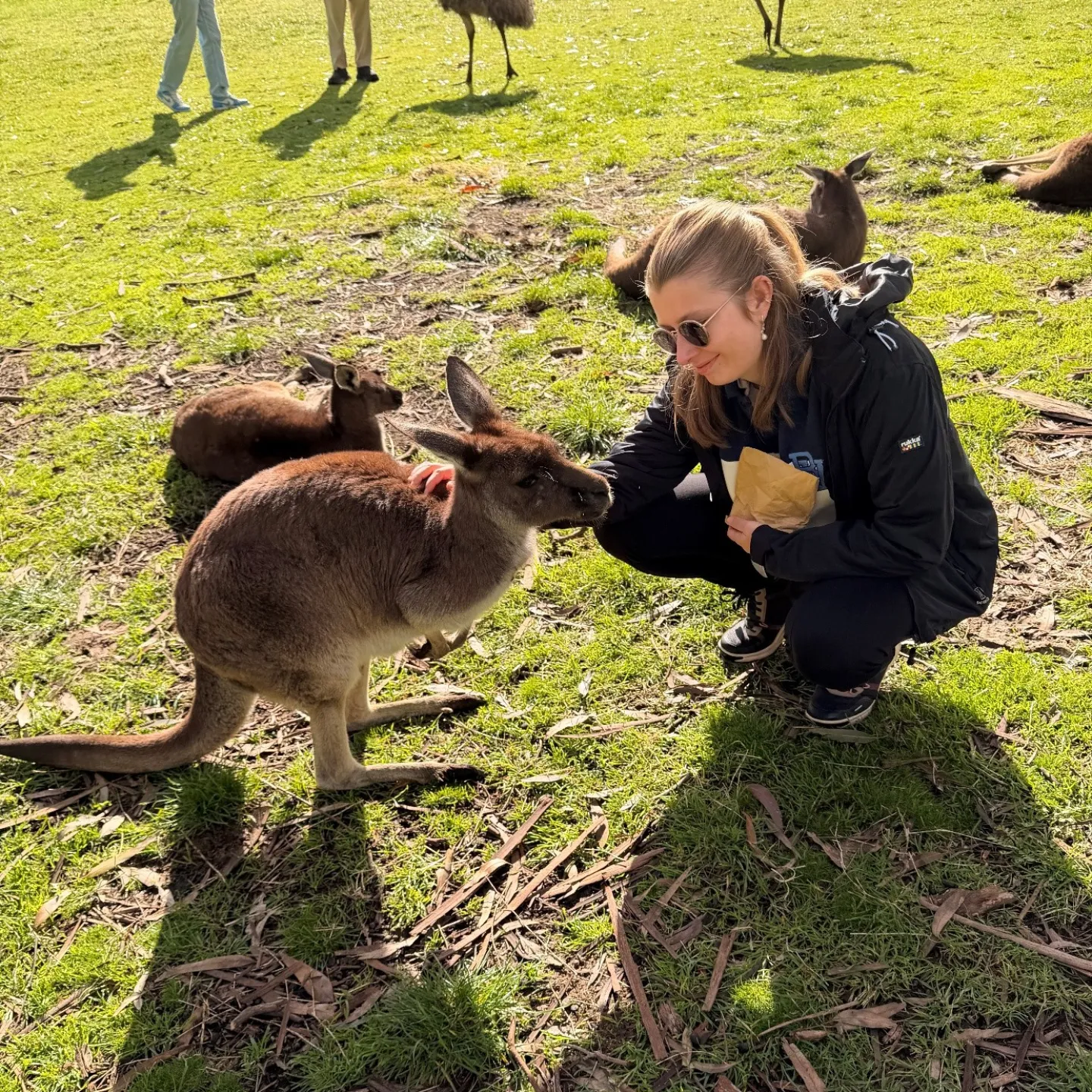
What’s more, all the Aussies I’ve met have been very helpful. Whether it was asking for directions or chatting in the nature reserve about which tree the koalas were hiding in. Sometimes, though, it’s not always easy to understand the Australian accent, as Australians tend to shorten a lot of their words. I’ve already learnt some of the most important words, and I’m looking forward to learning even more.