When machines help build the portfolio
When machines help build the portfolio
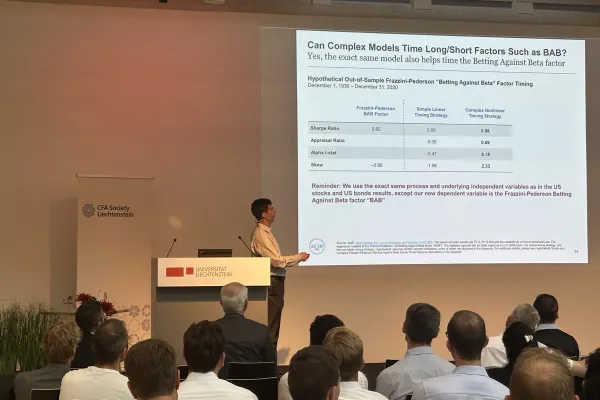
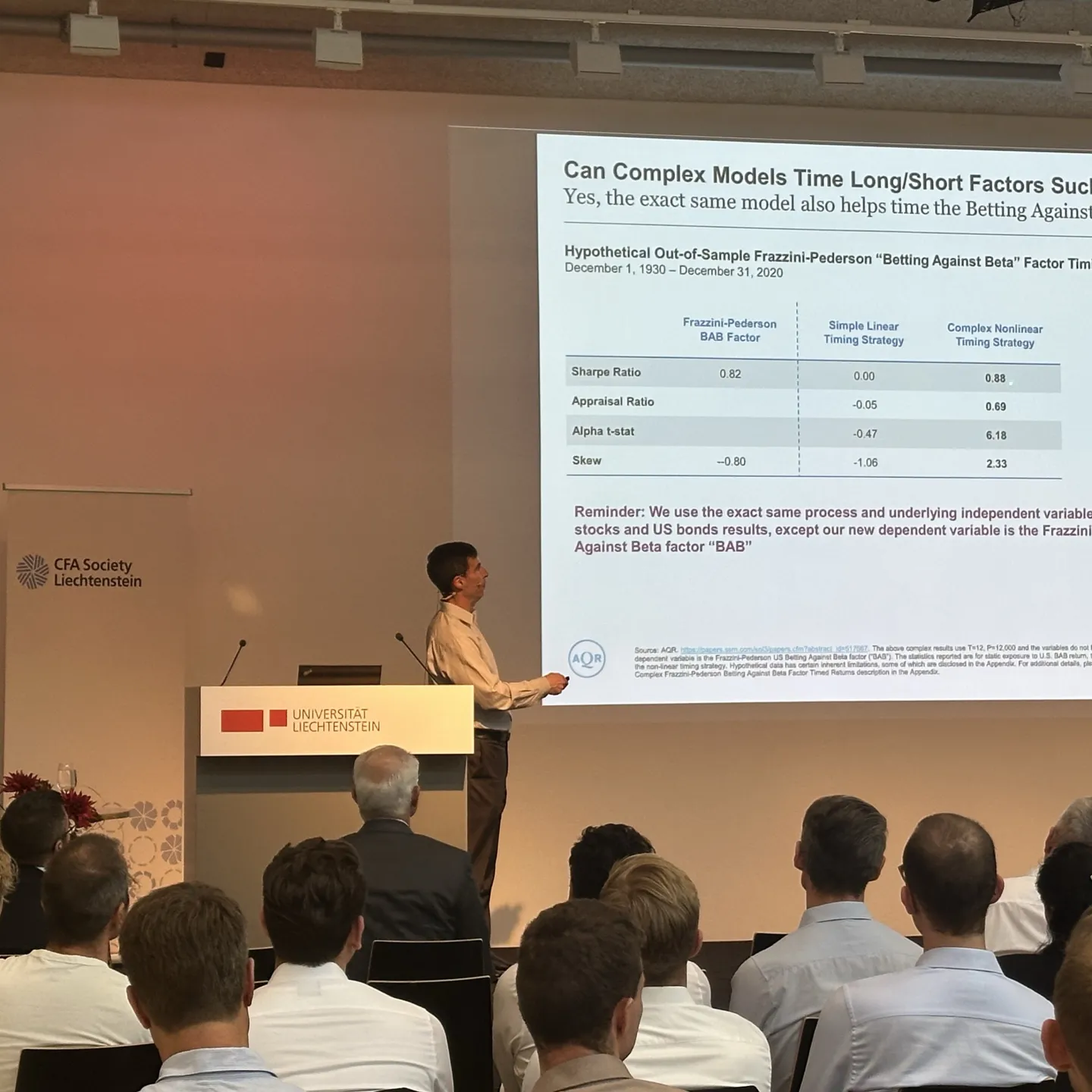
Can machine learning build better stock portfolios? Dr Peter Hecht of AQR Capital Management explored this question at the 62nd After-Work Lecture hosted by the University of Liechtenstein and CFA Society Liechtenstein. His answer: yes, but not without economic judgement.
Algorithms that read markets and shape investment decisions may sound futuristic, but in asset management they are already common practice. On 30 September, Dr Peter Hecht showed in the Auditorium of the University of Liechtenstein just how far machine learning can really go. As Managing Director and Head of the North America Portfolio Solutions Group at AQR Capital Management, Hecht brings experience from both academia and practice: he earned his PhD at the University of Chicago under Nobel laureate Eugene Fama, taught as an Assistant Professor at Harvard Business School and has held senior roles in portfolio management.
In his lecture, Hecht examined how machine learning can be applied to market timing, factor investing, stock selection and portfolio construction, and where its limits lie.
Economic judgement remains indispensable
Machine learning can optimise investment decisions, but it does not replace economic judgement, Hecht emphasised. In finance in particular, data sets are limited, the data is highly noisy and market relationships are constantly shifting. Without sound economic intuition, models can hardly be developed in a meaningful way.
Signal quality is also crucial. Even highly sophisticated models lose performance when weak or noisy variables are included. Anyone working with machine learning should therefore rely on economically meaningful inputs.
Where the strengths lie
According to Hecht, these methods add the most value where non-linear relationships are at play, which conventional approaches often miss. Many of the techniques are not new. However, it is only thanks to advances in cloud computing that they can now be tested and deployed efficiently and at scale.
His conclusion: the most powerful investment process combines economic intuition with statistical expertise. Finance is both an art and a science, and the best results emerge where the two come together.
Bringing academia and the financial centre together
The audience of finance professionals and students took the opportunity to ask numerous questions, and the lively discussion continued over the subsequent apéro. The After-Work Lectures are organised by the Chair of Innovative and Digital Finance at the University of Liechtenstein together with CFA Society Liechtenstein. The series regularly brings international experts to Vaduz and fosters exchange between research and the financial centre.